
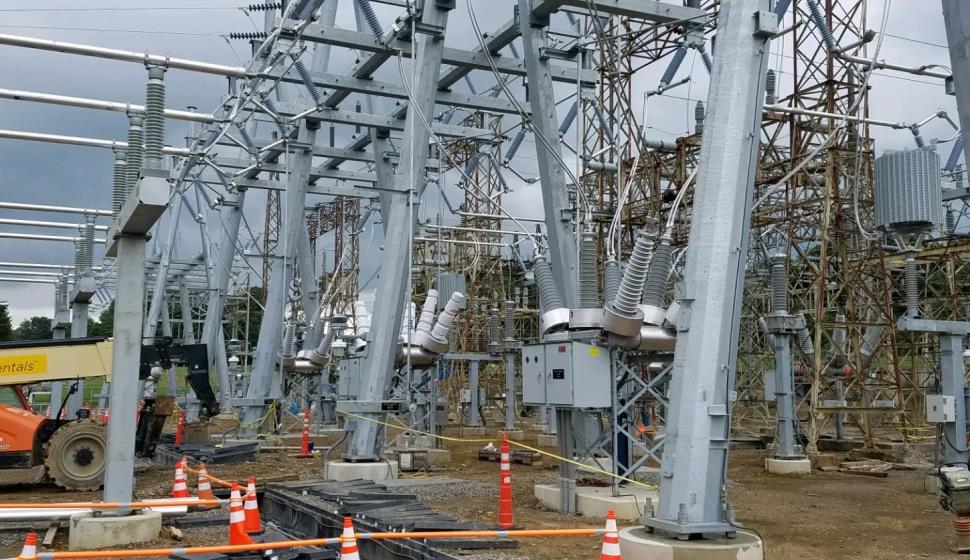
Pacific Gas and Electric Company (PG&E) initiated a USD 31 million project to reconfigure a 230-kilovolt section of the Ashlan substation, which supplies power to over 30,000 customers in Fresno, California.
The project required expanding the existing substation while maintaining uninterrupted power supply, introducing significant operational and safety challenges. The team needed to ensure a safe working distance between energized equipment and newly installed components, while also determining the optimal placement of a microwave tower to maintain signal performance.
Additionally, the brownfield nature of the site introduced complexities related to working within existing infrastructure, requiring accurate modeling and sequencing to avoid costly delays, safety risks, and construction conflicts.
To address these challenges, the project team implemented a digital workflow using Bentley Substation to model the greenfield design, alongside ContextCapture to create a 3D reality mesh of the existing brownfield conditions.
SYNCHRO was used to simulate and visualize the construction sequence, enabling the team to analyze project execution before on-site work began. This integrated approach allowed the team to capture accurate measurements, coordinate design elements, and evaluate construction logistics in a virtual environment.
By combining reality modeling with construction simulation, the team was able to identify potential issues early in the process and optimize both design and construction planning.
The use of digital modeling and simulation significantly improved project efficiency and reduced risks associated with construction in an active substation environment.
Through construction sequencing and simulation, the team identified a dead-end structure that needed to be removed prior to on-site work, preventing potential delays and hazards. This optimization saved three to four days in construction time and reduced costs by approximately USD 350,000 to USD 400,000.
The project demonstrated how integrating digital design, reality modeling, and construction simulation can enhance decision-making, improve safety, and optimize delivery for complex energy infrastructure projects.